At a glance
Learn when to request a wholesale supplier W-9, why inventory purchases differ from service payments, and which records liquidation buyers should keep with each order.

A wholesale supplier W-9 request can be sensible vendor onboarding, but buying inventory does not automatically create a federal Form 1099 filing requirement. For independent resellers, the important distinction is what the payment actually purchases: merchandise for resale, services, or a combination of the two.
Form W-9, Request for Taxpayer Identification Number and Certification, collects a U.S. payee’s tax identity and certifications. It is not a resale authorization, proof that merchandise exists, or a substitute for order records. For the broader documentation framework, start with PalletCove’s sales tax and resale certificate policy. A resale certificate is a buyer-provided document supporting a purchase for resale; sales tax is a state or local transaction tax. Valid resale certificates are reviewed and applied where the buyer’s state allows.
This article explains federal information-reporting distinctions and practical purchasing records, not individualized tax advice. Have a qualified tax professional assess your payment year, transaction type, and filing obligations.
What a supplier W-9 does—and does not do
A W-9 gives the requester the payee’s legal name, business or disregarded-entity name where applicable, federal tax classification, address, and taxpayer identification number, or TIN. The TIN may be an employer identification number or Social Security number, depending on the payee. The form also includes certifications and applicable exemption information.
The buyer generally retains the W-9 rather than sending it to the IRS. If an information return is required, the buyer uses the relevant identity information to prepare it. Requesting a W-9 does not itself mean that a Form 1099 must be filed.
Keep these documents separate:
| Document | Main purpose | What it does not establish |
|---|---|---|
| --- | --- | --- |
| Supplier W-9 | Records the payee’s federal tax identity and certifications | Ownership, available inventory, or merchandise quality |
| Buyer resale certificate | Supports a purchase for resale where accepted | The supplier’s federal tax classification |
| Invoice | Documents the seller’s charge, merchandise description, and transaction terms | Item-level testing or guaranteed resale outcomes |
| Manifest | Lists merchandise information supplied for a load | Accuracy beyond its stated scope or guaranteed condition |
| Payment confirmation | Records payment against an order | Whether federal reporting is required |
An invoice is the seller’s transaction document identifying what was charged and the applicable order details. A manifest is an inventory list, potentially including descriptions, quantities, or other fields; its scope depends on the listing.
The key question is not “Did I spend enough to need a W-9?” It is “What did I pay for, how did I pay, and does a federal reporting rule apply?”

Inventory purchases versus service payments
Payments for merchandise generally fall outside Form 1099-NEC and Form 1099-MISC reporting. Buying a liquidation pallet for resale is ordinarily a merchandise purchase. Purchasing a full truckload does not change that classification just because the invoice is larger.
Service payments require a different analysis. If a reseller separately hires a business to repair merchandise, photograph inventory, or provide consulting, those payments may fall within nonemployee compensation reporting rules, subject to the applicable threshold, payee classification, payment method, and exceptions.
For payments made in 2026, the general federal reporting threshold for covered nonemployee compensation is $2,000, increased from $600 for 2025. Inflation adjustments begin after 2026. This is not a universal threshold for every information return or payment category; consult the current IRS instructions for the year involved.
| Transaction | General federal reporting distinction |
|---|---|
| --- | --- |
| Purchase of overstock merchandise for resale | Merchandise payments generally are not reported on Form 1099-NEC or 1099-MISC |
| Purchase of customer-return inventory | The merchandise’s condition does not turn the purchase into a service payment |
| Separate payment for repair or consulting services | May require reporting, depending on applicable rules and exceptions |
| One charge combining services and related parts | Requires analysis; do not automatically exclude parts from a service engagement |
| Payment settled through a credit or debit card | Generally falls under payment-settlement reporting rather than the buyer’s Form 1099-NEC or 1099-MISC reporting |
Many corporate payees are exempt from ordinary nonemployee compensation reporting, but exceptions exist. An LLC label alone does not establish its federal tax treatment. That is one reason a completed W-9 can be useful for a genuine service vendor.
If an invoice combines inventory with a distinct service engagement, ask for clear descriptions. Do not invent allocations or assume every line labeled “merchandise” settles the question.
When buyers should request a W-9
Request a W-9 when you reasonably need the supplier’s certified tax identity for a potentially reportable relationship. Collecting it before a reportable service payment is usually easier than chasing information during filing season.
A consistent vendor-onboarding policy may also request W-9s from inventory suppliers. That is an administrative choice, not evidence that every inventory purchase requires a Form 1099.
Use this sequence:
- Identify whether the seller is providing goods, services, or both.
- Determine the payment method and relevant reporting year.
- Ask your bookkeeper or tax professional whether an information return may be required.
- If needed, request the supplier’s current completed W-9 through a verified contact.
- Resolve unexplained differences between the tax identity and order documents.
- Retain the form securely and update it when relevant supplier information changes.
A trading name can legitimately differ from the legal name on the W-9. Ask for an explanation rather than assuming either fraud or an error. Follow current form instructions for the applicable entity type; do not complete the supplier’s certifications yourself.
A W-9 has no routine annual expiration, although changed names, TINs, classifications, or certifications can make an update necessary. Foreign payees generally use an applicable W-8 form rather than Form W-9; obtain professional guidance for those relationships.
Missing or incorrect tax information can create backup-withholding issues for certain reportable payments. It does not mean buyers should automatically withhold from ordinary inventory purchases.
Card payments and secure supplier verification
PalletCove accepts only credit and debit cards: Visa, Mastercard, American Express, and Discover. After order review, a secure card link is emailed to the buyer. No payment is collected on the website order form. Review the wholesale order payment policy before submitting payment.
Payment-card transactions generally belong to the payment-settlement entity’s Form 1099-K reporting framework. Buyers generally should not duplicate those transactions on Form 1099-NEC or Form 1099-MISC. Whether a settlement entity issues a particular form is separate from the buyer’s bookkeeping responsibilities and the supplier’s income reporting.
Supplier vetting means checking a seller’s identity, transaction terms, and ability to fulfill the proposed order. A W-9 supports one part of that process, but a convincing form can still accompany a misleading offer. Confirm order details and unexpected changes through independently verified contact information. The guide to liquidation supplier payment scam warning signs addresses that separate risk in more detail.
Because a W-9 contains sensitive identity information:
- Ask the supplier how to exchange it securely.
- Limit access to staff who need tax or accounting records.
- Avoid placing TINs in shared inventory spreadsheets or public documents.
- Keep the form separate from routine warehouse paperwork.
Match the tax file to the actual liquidation purchase
A useful supplier file connects tax identity to the actual order without treating either as proof of the other. Browse the liquidation pallets hub for inventory context, and use the liquidation pallet buying guide or truckload purchasing guide for load-selection questions.
PalletCove sells category-level liquidation pallets and full truckloads. A pallet purchase may move through an LTL, or less-than-truckload, freight network; a truckload purchase involves full-trailer planning. Confirm shipment configuration and receiving requirements for the specific order rather than inferring them from a product name.
The general merchandise category and truckloads category illustrate different inventory groupings. For a specific purchase, retain the listing details from pages such as the Shoes Truckload listing or Macy’s Textile Truckload listing, along with the invoice. These names are not guarantees of availability or condition. PalletCove is an independent reseller, not affiliated with, endorsed by, or sponsored by any retailer named.
A condition grade is the listing’s description of merchandise condition, not a tax classification:
- Overstock generally describes excess inventory; it does not independently establish new condition.
- Shelf pulls have been removed from selling locations and may show handling or packaging wear.
- Customer returns have been returned by purchasers and can vary in completeness and functionality.
- Salvage indicates inventory requiring especially careful review of its stated limitations.
- “As-is” language should be read alongside the description and applicable claims terms, not treated as a universal no-returns rule.
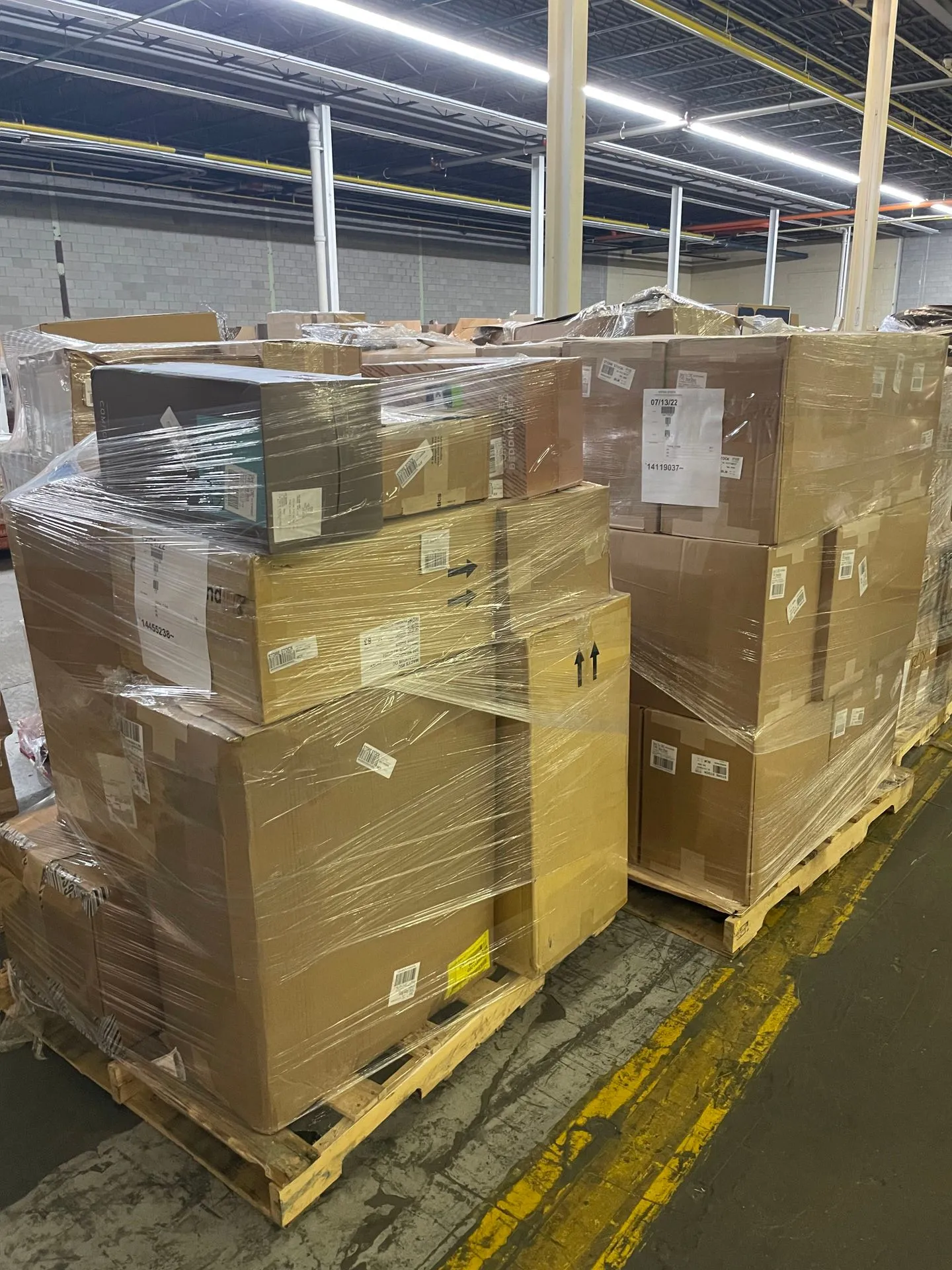
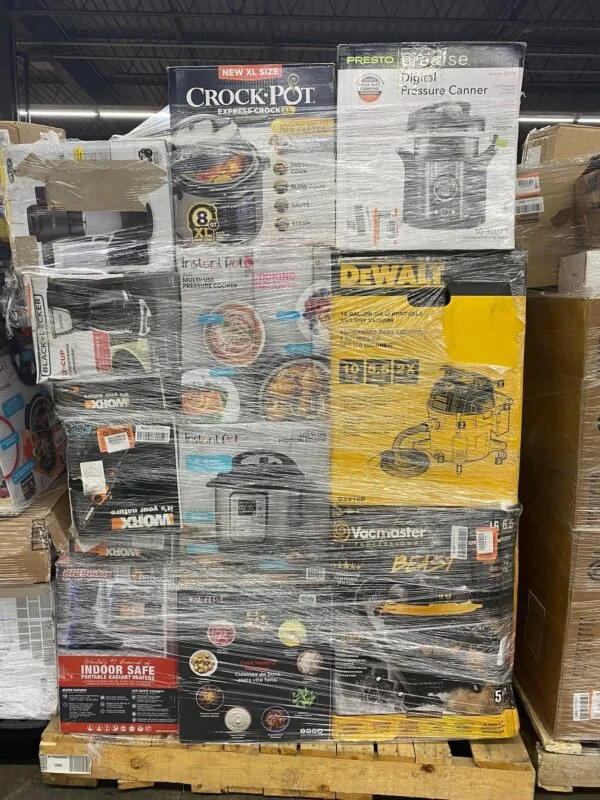
Photos show representative loads. Contents of each pallet vary, pallets are not individually tested, and contents are sold as described in the listing. Ask whether a manifest exists and whether it is load-specific or illustrative. A W-9 cannot resolve uncertainty about quantities, condition grades, or manifest scope.
Keep one complete order record through delivery
Save the reviewed order, invoice, listing description, available manifest, payment confirmation, correspondence, and delivery documents together. Maintain supplier tax forms in a restricted accounting file linked to that order history. For ongoing organization, see record-keeping for liquidation inventory purchases.
Freight is included in the listed price. Free shipping is the only delivery option on every PalletCove order to all 48 contiguous states, including orders for liquidation pallets in Texas and liquidation pallets in Florida.
Handling takes 1–3 business days after payment clears. Transit from Houston is typically 3–7 business days, for an estimated 4–10 business days total. The processing cutoff is 2:00 PM Central Time, America/Chicago, Monday–Friday; after-cutoff confirmations begin the next business day. Weekends and applicable holidays do not count.
At delivery, inspect accessible exterior packaging, compare the shipment with the delivery paperwork, and document visible damage or discrepancies with photographs and written notes. Request delivery-issue reporting within 48 hours so the order desk can assess the record promptly.
Under the refund and returns policy, U.S. products explicitly listed as NEW ONLY qualify for defective and non-defective returns and exchanges within 30 calendar days of delivery. Returns are by mail; the customer is responsible for the return label and shipping, and a 15% restocking fee applies to the product price. Refund processing takes 10 calendar days after authorized return receipt and inspection, or approval where no physical return is required.
Mixed and used loads have separate claims terms, not routine change-of-mind returns. The requested 48-hour delivery-issue report does not shorten eligible new-product 30-day returns.

Common wholesale supplier W-9 mistakes
The most frequent mistakes come from treating unrelated documents as interchangeable:
- Applying a reporting threshold to every purchase. Establish the payment category first.
- Assuming a large truckload invoice requires Form 1099-NEC. Merchandise does not become compensation because of its price.
- Confusing the buyer’s resale certificate with the seller’s W-9. They serve different purposes and identify different parties.
- Treating the W-9 as supplier approval. Verify the order, identity, and terms separately.
- Ignoring card settlement. Consider payment method before preparing information returns.
- Using a manifest instead of an invoice. Preserve both when available; they answer different questions.
- Assuming a tax form validates condition. Only the applicable listing and transaction terms describe the purchase.
Frequently asked questions
Do I need a W-9 to buy a liquidation pallet?
A merchandise purchase does not automatically require a W-9 for federal information reporting. Your business may still request one under its vendor-onboarding policy.
Must I issue a 1099 for a large inventory order?
Payments for merchandise generally are excluded from Form 1099-NEC and Form 1099-MISC reporting. A larger order total alone does not change that treatment.
Does a supplier W-9 replace my resale certificate?
No. A W-9 records the supplier’s federal tax identity, while a resale certificate supports the buyer’s purchase for resale. Valid resale certificates are reviewed and applied where the buyer’s state allows.
Should I request a W-9 for separately purchased services?
It can be appropriate when the service relationship may create reporting obligations. Have your tax professional consider the reporting year, payee classification, amount, payment method, and exceptions.
Does a completed W-9 prove a supplier is legitimate?
No. It is a tax identity document, not proof of inventory ownership or fulfillment capacity. Check the seller and the transaction independently.
Talk to PalletCove Liquidation
Request a wholesale supplier W-9 when your accounting process or a potentially reportable relationship calls for it—not simply because an inventory order is large. Keep the supplier’s tax identity, merchandise records, and payment classification distinct. For the broader documentation context, review our sales tax and resale certificate requirements.
For order-document questions, contact our order desk or browse current inventory.
PalletCove Liquidation LLC
4000 Telephone Rd Unit B11, Houston, TX 77087
Phone: (713) 819-3904
Email: sales@palletcoveliquidation.com
Hours: Mon–Fri 8:00 AM – 6:00 PM CT, Sat 9:00 AM – 2:00 PM CT, Sun closed.
About PalletCove Liquidation
Published by PalletCove Liquidation LLC, based in Houston, Texas. Our buying guides cover evaluating liquidation inventory and preparing for delivery. Consult the current product listing and store policies for purchase terms.